Should Claude Code Access Your Files? A Safer MCP Setup
Should Claude Code Access Your Files? A Safer MCP Setup
Claude Code is powerful because it can do more than answer questions.
It can inspect code, edit files, run commands, and connect to external tools. But the more access it receives, the more important one question becomes:
Should Claude Code have access to all your files?
The short answer is no.
Claude Code should only access the information required for the current task. It should not need unrestricted access to your Mac, personal folders, or years of private documents.
Fenn now makes this possible through MCP. Claude Code can search Fenn’s local index and retrieve relevant content without using the Fenn connection to browse your entire file system.
But there is still an important privacy boundary: anything retrieved by Claude Code may be processed by Anthropic or another configured model provider.
Why file access deserves more attention
Your Mac probably contains much more than code.
It may include:
Personal notes
Client documents
Contracts
Financial information
Research
Internal company material
Private archives
Years of accumulated knowledge
Giving an AI agent access to a folder can feel like a simple permission. In reality, it is a trust decision.
The issue is not whether Claude Code is useful. It clearly is.
The issue is how much it needs to see to complete the task.
Claude Code is not a local-first tool
Claude Code runs from your terminal and can execute commands locally. It can also connect to local MCP servers running directly on your Mac.
But compatibility with local tools does not make a product local-first.
The Claude models are proprietary and controlled by Anthropic. In the standard setup, your prompts and relevant context are sent to infrastructure operated by Anthropic. Claude Code can also be configured with other cloud providers, but that still does not make the model local.
The terminal is local. The files may be local. The MCP server may be local.
The model processing the retrieved information usually is not.
That distinction matters.
Privacy depends on your Claude Code setup
Anthropic applies different data policies depending on your account, settings, and how you access Claude Code.
For consumer accounts such as Claude Free, Pro, and Max, Anthropic says chats and coding sessions may be used to improve Claude if you enable that setting. Anthropic also says data allowed for model improvement may be retained in a de-identified form for up to five years.
Deleting a conversation removes it from your history immediately, but Anthropic says deletion from its back-end systems can take up to 30 days. Sessions flagged by automated safety systems may be retained for longer.
Commercial products, API usage, and Enterprise agreements can have different training and retention terms. Zero Data Retention is also limited to eligible products, models, and approved arrangements.
You can review the current details in the Anthropic Privacy Center.
These controls can reduce exposure. They do not turn Claude Code into a local AI tool.
Privacy is not only about training
Privacy discussions often stop at one question:
“Will my data be used to train the model?”
That is important, but it is not the complete issue.
Privacy also concerns:
Where your information is processed
What content is transmitted
How long it may be retained
Whether logs or monitoring systems contain it
Who controls the infrastructure
What happens when policies change
Whether access can be restricted, suspended, or removed
Even when model training is disabled, selected content still needs to leave your Mac for a cloud model to process it.
You are trusting the provider’s current policies, security, internal controls, and future incentives.
The strongest protection is still data minimization: do not share information that the task does not require.
A safer way to connect Claude Code to your files
Fenn creates a private search index on your Mac.
Through the Fenn MCP connection, Claude Code can ask Fenn to:
Search indexed files
Browse indexed folders
Read relevant content already stored in the index
Find exact pages, slides, lines, or timestamps
All Fenn MCP tools are read-only.
Through this connection, Claude Code cannot modify, move, rename, or delete your files. It also cannot use Fenn to search folders that you have not indexed.
Claude Code supports local MCP servers through the open Model Context Protocol. You can learn more about that architecture in the official Claude Code MCP documentation.
Instead of giving Claude Code broad access just to find something, Fenn provides a smaller and more controlled search layer.
Fenn gives Claude Code a window, not the keys to the house.
What the Fenn connection can and cannot do
Through Fenn MCP, Claude Code can search and read content from your Fenn index.
It cannot use Fenn to:
Edit your files
Delete your files
Move or rename files
Search unindexed folders
Run arbitrary commands on your Mac
Claude Code may still have separate access to files inside its current project or working directory, depending on its own permissions. That access is independent of Fenn.
The Fenn connection does not expand Claude Code’s general filesystem permissions.
What remains private?
Fenn’s index stays on your Mac. Searching and ranking happen locally.
However, when Claude Code asks Fenn to retrieve a result, the returned filename, text, or other indexed content becomes available to Claude Code. That content may then be sent to the configured model provider as part of the task.
Fenn does not make Claude Code private.
What it does is reduce unnecessary exposure.
Without Fenn, you might give Claude Code access to a large folder and let it inspect files directly. With Fenn, Claude Code can search first and retrieve only the content relevant to your request.
That is a meaningful improvement, but it is not the same as keeping the complete workflow on-device.
How to connect Claude Code to Fenn
Open Fenn.
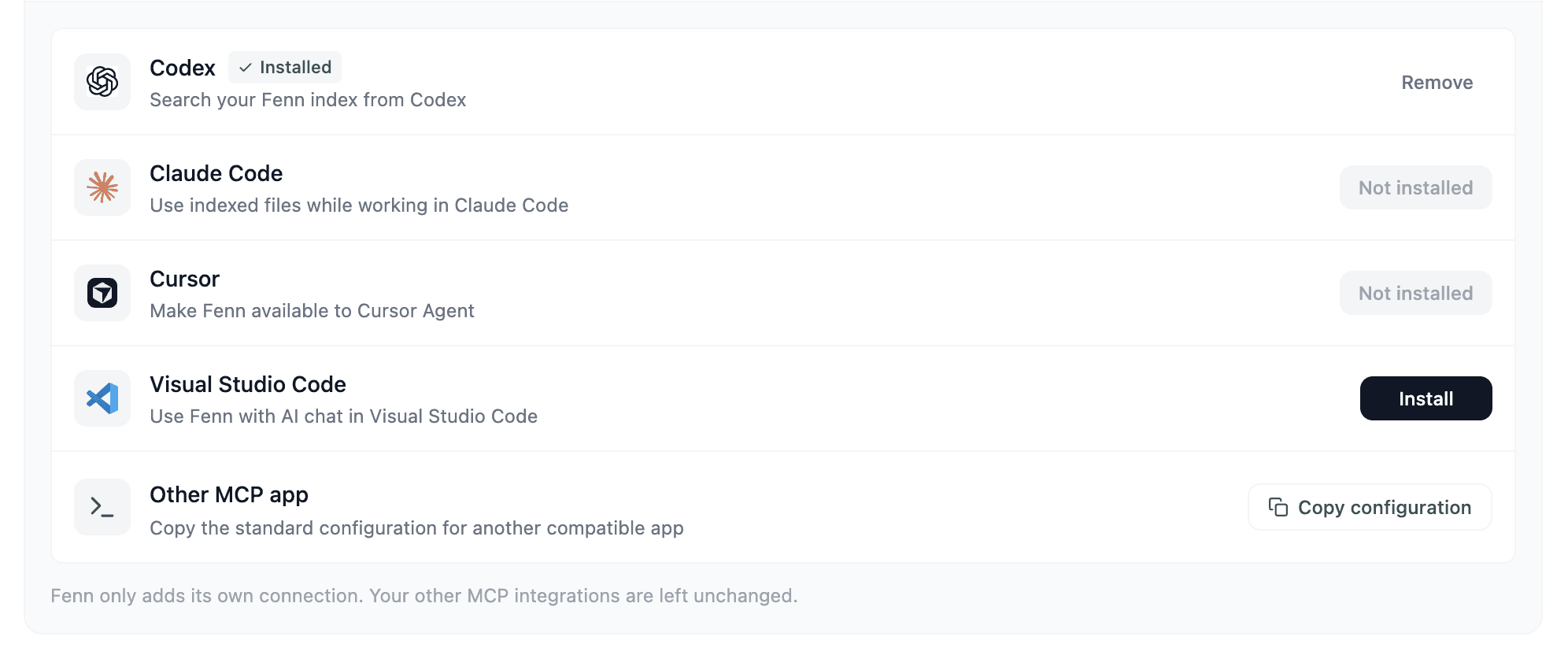
Go to Settings → Search & AI.
Scroll to Use Fenn with other AI apps.
Find Claude Code and click Install.
Restart Claude Code if requested.
Run
/mcpin Claude Code to check that Fenn is connected.
You can then ask something like:
Use Fenn to find the documents about the website launch and summarize the key decisions.
Or:
Search Fenn for the presentation where we discussed the new pricing strategy.
Claude Code can search through Fenn without requiring you to find and attach each file manually.
How to use the connection safely
A few simple rules make the workflow safer:
Only index folders you want Fenn to search.
Ask focused questions instead of requesting broad exploration.
Review what Claude Code retrieves before continuing with sensitive work.
Keep Claude Code’s own filesystem permissions limited.
Remember that read-only does not mean fully private.
Keep highly confidential information inside local tools.
A useful rule is:
If you would not deliberately paste something into Claude Code, do not ask Claude Code to retrieve it through Fenn.
When should you avoid using Claude Code?
Some information should remain entirely on your device.
This might include:
Confidential client material
Medical or legal documents
Private journals
Passwords and recovery information
Sensitive financial records
Documents covered by strict contractual requirements
For these files, use Fenn’s local search and local AI features without sending the results to a cloud-based assistant.
The most private request is the one that never leaves your Mac.
The bottom line
Should Claude Code access your files?
Not broadly.
Claude Code is a powerful assistant built by a closed AI company. Local commands, permission settings, and MCP compatibility can reduce risk, but they do not make Claude Code a local-first product.
Fenn MCP offers a more controlled approach.
It allows Claude Code to search a private local index using read-only tools, instead of giving the Fenn integration unrestricted access to your file system. You decide which folders are indexed, and Claude Code retrieves only the information required for the task.
The retrieved content may still leave your Mac. That remains the privacy boundary.
Use local tools to find what matters. Use cloud AI selectively. Share only what is necessary.
That is how you benefit from Claude Code without giving it more access than it needs.
Read also
Should Codex Access Your Files?
Learn how to connect Codex to your Mac files while limiting unnecessary access.Can You Trust Anthropic and Claude?
Explore the wider trust, control, and privacy questions surrounding Anthropic.Use LM Studio With Your Mac Files
Use local AI models with your files when information must remain entirely on your Mac.