Apple Keynote 2026: What It Means for AI and Privacy

Apple Keynote2026 : What It Means for AI and Privacy
Apple’s September keynote introduced new iPhones, new cameras, a foldable device, and the usual performance improvements.
But the most important announcement may not be a product people can see.
It is the direction Apple is taking with artificial intelligence: more AI running directly on our devices, closer to our personal data, without automatically sending everything to a remote server.
The new A20 Pro chip is part of that story. Not because people should care about processors or benchmarks, but because it gives Apple considerably more power to run AI locally.
The keynote offered a glimpse of a future where your most personal AI may live inside your phone or computer, not inside a data center.
The short answer
Apple’s strategy appears to be:
Run as much AI as possible directly on the device.
Use private cloud infrastructure when a request is too complex.
Give AI access to personal context without collecting all that context centrally.
Make local AI available to third-party apps, not just Siri.
This matters because useful personal AI needs access to sensitive information: messages, emails, photos, documents, meetings, browsing activity, and everything else we create or consume.
The more personal AI becomes, the more important it is to control where that information is processed.
Why the A20 Pro matters
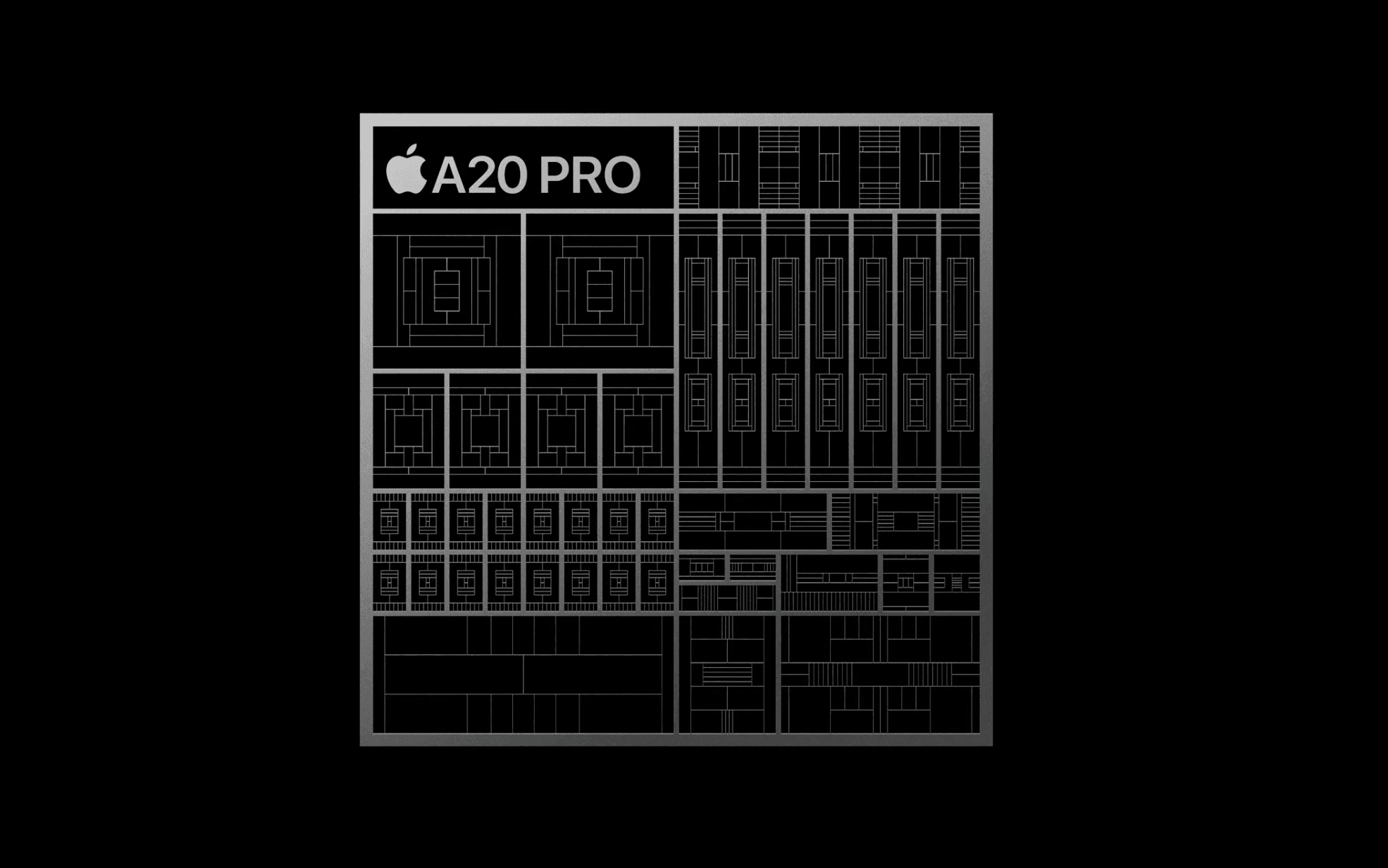
Apple says the A20 Pro provides twice the AI processing power of its predecessor, along with more memory capacity and better sustained performance.
In simple terms, the new iPhones can run more demanding AI models without relying as heavily on the cloud.
That can make AI:
Faster, because information does not need to travel to a server.
Available offline.
Less expensive to operate because there is no cloud request for every action.
More private because personal information can remain on the device.
The chip itself is not the interesting part. What it enables is.
Apple is gradually turning the iPhone from a device that connects to AI services into a device capable of running its own AI.
Apple describes the A20 Pro as having twice the AI processing power of the previous generation.
AI is becoming more personal
The new version of Siri can use information from messages, emails, photos, and what is currently visible on the screen to understand a request.
This is much more useful than an assistant that only has access to a question typed into a chat window.
You could ask it to find a reservation mentioned in an email, understand something displayed on your screen, or take an action based on a conversation you had several weeks ago.
But this creates an obvious privacy question: how much of your digital life needs to be uploaded before an AI can help you?
Apple’s answer is to process simpler requests locally and send only more complex requests to its Private Cloud Compute infrastructure.
Does everything stay on the iPhone?
No and this distinction is important.
Apple Intelligence first determines whether a request can be handled on the device. More demanding requests can still be sent to the cloud.
Apple says that Private Cloud Compute only receives the information required for the request, does not store that information, and prevents Apple from accessing it. Its software can also be inspected by independent security researchers.
Apple has recently expanded this system to use NVIDIA hardware in Google Cloud while claiming to maintain the same protections. Apple explains the expanded architecture here.
Therefore, Apple’s approach is not completely local. It is a hybrid between local and private cloud AI.
That is still meaningfully different from sending every message, document, and interaction to a conventional AI service but users should understand the difference.
A future where today’s cloud AI runs in your pocket
Now imagine where this direction could lead.
Today, the most powerful AI systems require enormous data centers. Models such as GPT-5.6 rely on infrastructure that cannot fit inside a phone.
But AI models are becoming more efficient while personal devices are becoming considerably more powerful.
It is reasonable to imagine a future where every iPhone or Mac can run an AI as capable as today’s leading cloud models, entirely on the device.
This is not something the A20 Pro can do today, and there is no guarantee about when it will happen. But the direction is increasingly visible.
In that world, your personal AI could:
Understand everything you have saved, read, watched, or heard.
Remember information across your apps.
Help with private documents and conversations.
Work without an internet connection.
Adapt to you without sending your personal history to an AI provider.
Instead of using the same remote assistant as millions of other people, everyone could have a powerful private model running on hardware they own.
Local AI could change what users expect from apps
As local models improve, uploading personal data to a server may stop feeling like the default.
People may begin asking different questions:
Why does this app need to upload my files?
Can this feature work offline?
Who can access the information being processed?
Is my data being retained or used for training?
Could the same task happen directly on my device?
Apple is also giving developers tools to run their own models locally. Its Core AI framework supports models that operate without servers, internet access, or per-request API costs. Apple’s Core AI documentation confirms that these models can run entirely on Apple devices.
This may be more significant than any individual Siri feature. It means thousands of apps can begin offering AI capabilities without requiring users to surrender their data.
This future is already beginning on the Mac
You do not need to wait for a future iPhone to experience useful local AI.
Fenn uses private AI on your Mac to help you find anything you saved, saw, heard, or said.
It can search inside documents, PDFs, images, videos, audio, presentations, and other files. It can also help you return to a specific screen, page, frame, or timestamp instead of simply showing you a filename.
The processing happens locally. Your files are not uploaded to an AI provider, and Fenn can work offline.
This is a focused example of what personal AI can become: software that understands your information well enough to help you, without requiring you to give that information away.
Learn more about Fenn and private AI for Mac.
The transition will not happen overnight
Local models are still smaller and less capable than the largest cloud systems. Older devices may not have enough memory or processing power, and some requests will continue to require cloud infrastructure.
Availability is another limitation. Apple has said that Siri AI will not initially launch in the European Union, even though the new hardware will be available there.
The near future will therefore remain hybrid: local AI for speed, privacy, and everyday tasks, combined with private cloud systems for more difficult requests.
But every generation of hardware moves that boundary.
Tasks that require a server today may happen privately on a phone tomorrow.
The most important message from Apple’s keynote
Apple’s keynote was not simply about faster iPhones.
It showed that privacy and AI performance are becoming connected. The more capable our devices become, the less personal information needs to leave them.
The A20 Pro is another step toward a world where powerful AI belongs to the user, runs on hardware they own, and understands their digital life without exposing it.
We are not fully there yet. But the transition from cloud-first AI to personal, local AI has clearly begun.