ChatGPT Ads Are Coming: What OpenAI Announced
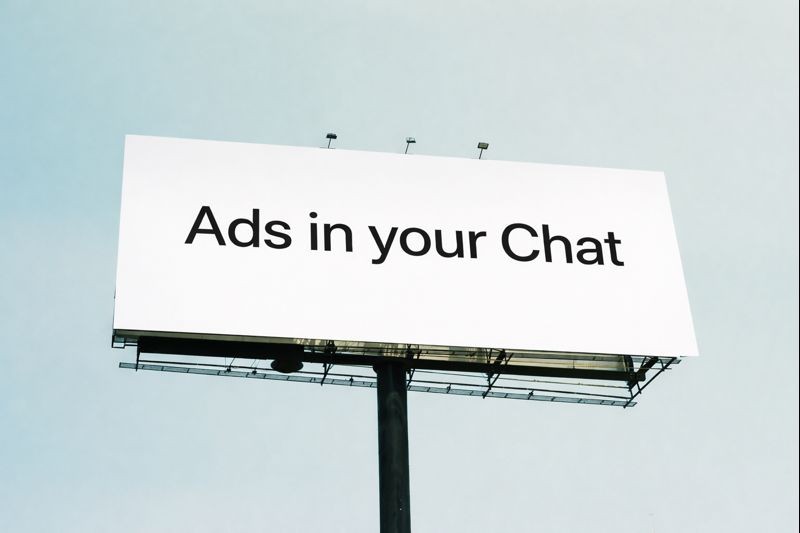
OpenAI says it will start testing ads in ChatGPT for some users in the United States. If you use ChatGPT daily, this is a meaningful shift, not because ads are surprising, but because ads change incentives. When a product earns money from attention and targeting, trust becomes part of the product.
This post covers what OpenAI announced, what it means in practice, and why privacy-first tools matter more than ever.
What OpenAI announced
OpenAI’s plan, in plain English:
Ads will be tested for logged-in adults in the U.S. on the Free tier and the lower-priced Go plan.
Ads will appear separately from answers, and OpenAI says ads will not influence what ChatGPT responds.
OpenAI says user conversations will not be shared with advertisers.
Plus, Pro, Business, and Enterprise tiers will remain ad-free.
OpenAI says it will avoid showing ads to users under 18, and it plans to restrict ads around sensitive topics like health and politics.
The first format is expected to place clearly labeled sponsored content at the bottom of answers when it is relevant.
The question professionals will ask next: will ads reach paid plans?
Right now, the ads test is limited to Free and Go. But many professionals rely on ChatGPT’s paid plan for day-to-day work, and a common assumption is:
“I pay, so I will never see ads.”
OpenAI has said Plus, Pro, Business, and Enterprise will not include ads during this rollout. There is no public timeline that suggests ads are coming to paid tiers.
At the same time, it is reasonable to ask the uncomfortable question: if ads become a major revenue driver, will the boundary between “ad-supported” and “ad-free” stay fixed forever?
We simply do not know. But this is the moment to think about how much of your workflow you want dependent on a platform whose business model can evolve.
Why ads change the incentives
Even if ads are “separate from answers,” ads still shape product strategy over time. The core question becomes:
Is the product optimized for your outcome, or for what keeps you engaged?
OpenAI says it will prioritize user trust and not optimize for time spent. That is a good principle. But ads introduce a second set of stakeholders, and that is where cautious users start to reassess what tools they rely on for private, sensitive work.
The real issue for most people: where does my data go?
A lot of people use ChatGPT for personal and work tasks that are not trivial, including:
pasting confidential snippets
uploading files
discussing internal projects
drafting sensitive documents
OpenAI says it will not sell your data to advertisers and that conversations remain private from marketers. Even with that assurance, many teams still have strict rules: sensitive files must not be uploaded to third-party cloud AI tools at all, regardless of promises.
That is where “private by design” becomes the deciding factor.
A private alternative for your personal files
If your goal is to understand your own documents, you do not always need a cloud chatbot. You need a private workflow on your computer.
That is the approach behind Fenn.
Fenn is paid software, it is built to be ad-free, and ads are not part of the business model. Your data stays yours.
The simple workflow: index, search, find, chat
Here is the workflow that tends to click for most people:
Index your files
You choose the folders and sources you want to include.Search
Use normal search to find the right file fast, even if you remember the idea instead of the filename.Open the result
Jump into the file you need.Click “Chat with this file”
Switch to Chat mode to interact with the file privately.
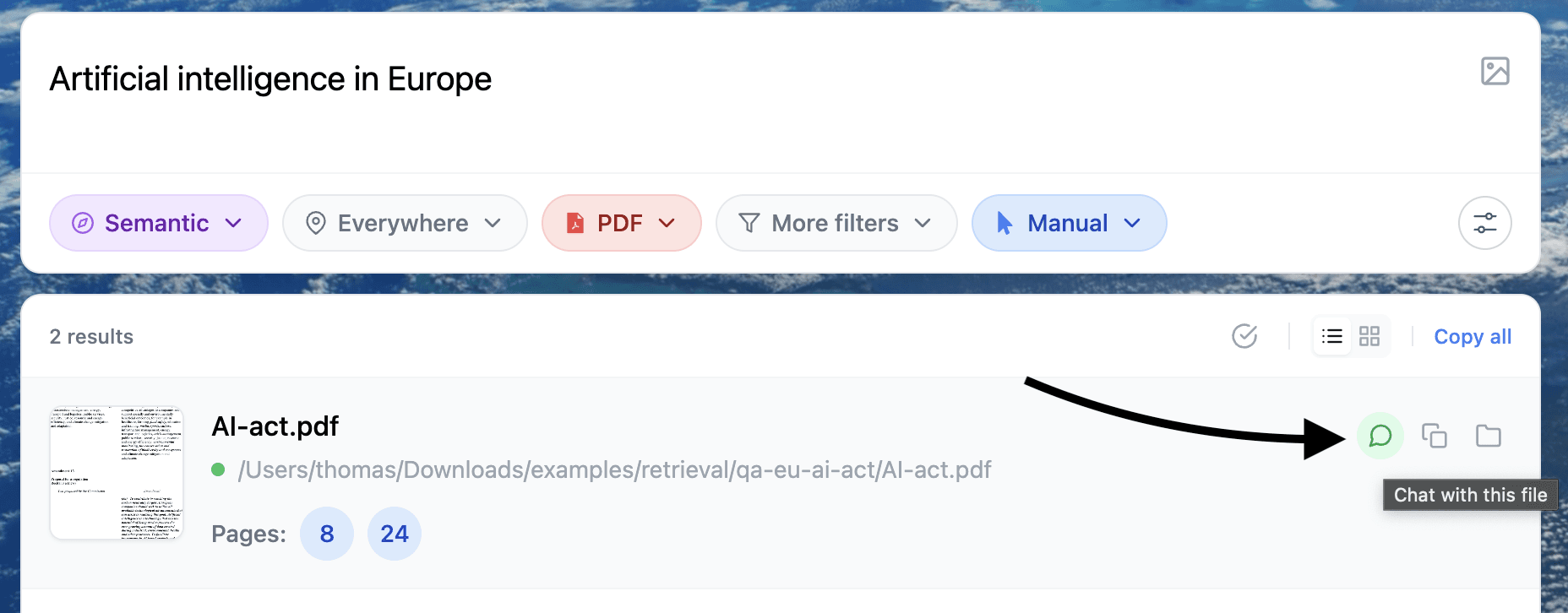
Search and find the file you need using Semantic search
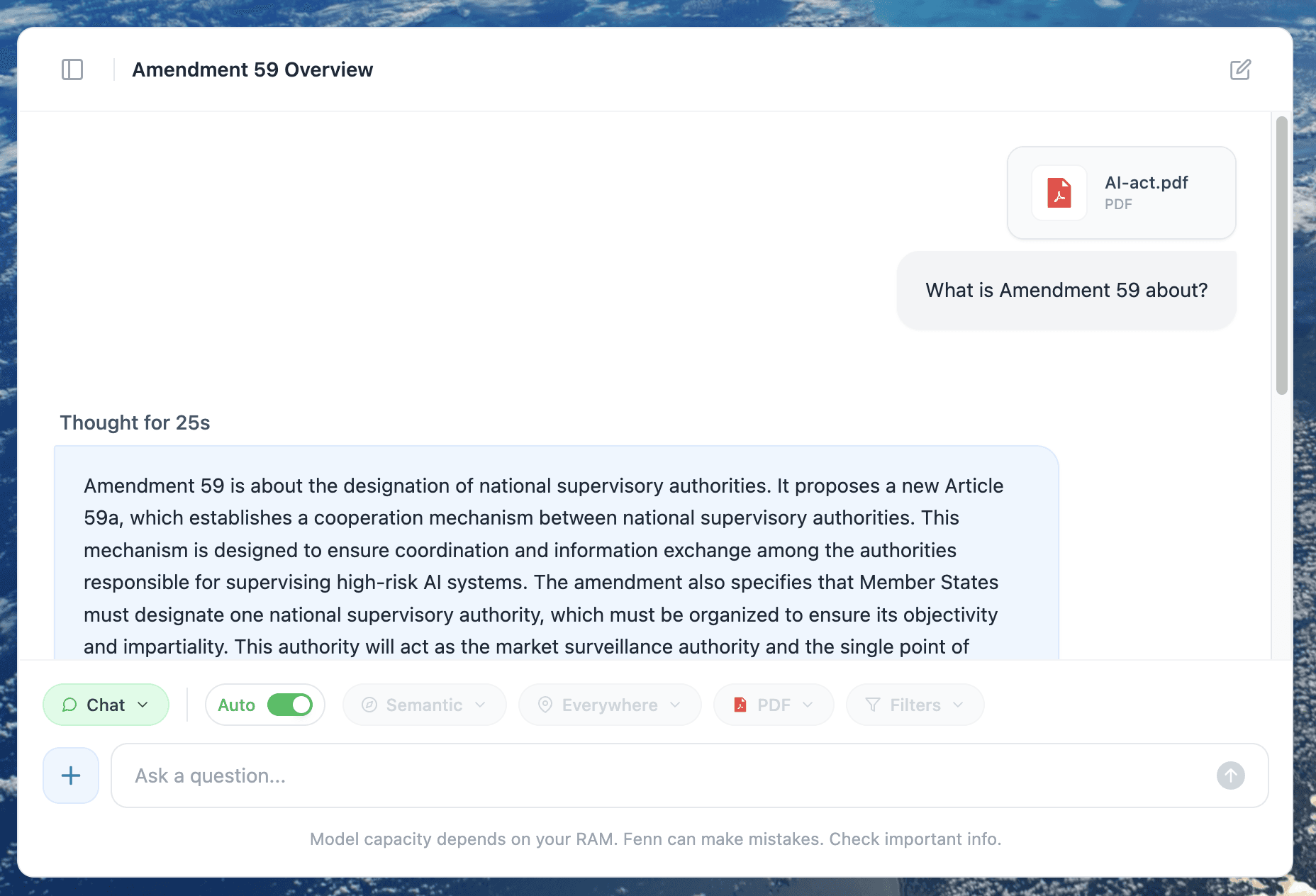
Ask questions and get answer 100% privately
What you can do in Chat mode
Once you are chatting with a specific file, common tasks include:
Summarize a PDF into bullet points
Extract key fields like dates, amounts, names, and requirements
Ask questions and get direct answers from the document
Turn a long report into action items or a checklist
The point is not “AI for everything.” The point is using AI where it saves real time, without exposing confidential material.
Why Fenn stays ad-free
Ads require data and targeting. Even if a company tries to do it carefully, the model pushes toward personalization, measurement, and optimization.
Fenn’s model is the opposite:
It runs on your Mac
It is paid, not ad-funded
Ads and data selling are not part of the business model
Your data is not sent to external AI model providers
Your data is not used to train third-party models
Your files are not packaged into signals for advertisers
Who should care most about this shift
If you work with any of the following, an ad-funded AI future is a good moment to revisit your tooling:
client contracts and legal docs
finance and accounting files
internal strategy and planning
research notes and unpublished work
HR or hiring documents
anything under NDA
For these workflows, “private by default” is not a preference, it is often a requirement.
Read also
If you want AI help without ads and without sending your files to third parties, use a private workflow.
Index your files, search, find what you need, then click “Chat with this file,” privately on your Mac.